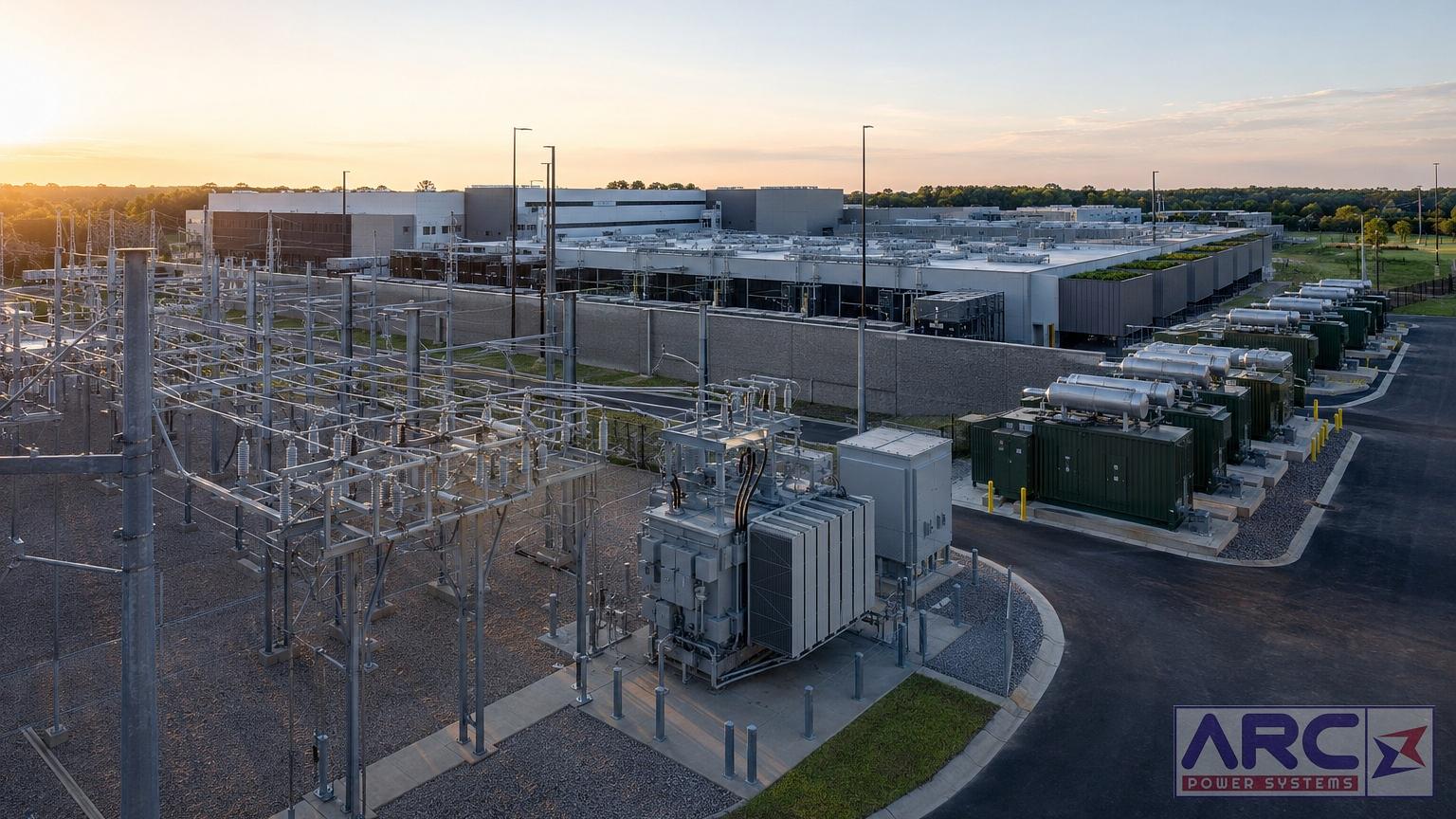
Artificial intelligence is changing more than software. It is changing how quickly large electrical loads are being planned, where new power plants are needed, and how early developers must secure generators, turbines, transformers, fuel, and related infrastructure.
For an AI data center, the critical question is no longer simply, "Can the utility serve this site someday?" The more useful question is, "What dependable power can this project secure, permit, deliver, and operate on its actual schedule?"
The practical answer is to treat power-equipment procurement as an early project workstream. Developers should evaluate utility service, on-site generation, bridge power, backup power, fuel supply, emissions, voltage, frequency, interconnection, and long-term operating duty before land, construction, and computing commitments outrun the available megawatts.
ARC Power Systems helps qualified buyers work through that market. We source and sell industrial generators, gas turbines, transformers, and power-plant equipment; support project-specific custom-build orders; and help negotiate large, multi-unit equipment purchases in domestic and international markets.
The AI Data Center Electricity Surge Is Already Here
The numbers explain why power has moved to the front of the development schedule.
The International Energy Agency's updated 2026 outlook projects that global data-center electricity consumption will roughly double from 485 terawatt-hours in 2025 to about 950 terawatt-hours in 2030. Within that total, electricity use by AI-focused data centers is projected to triple.
In the United States, a Lawrence Berkeley National Laboratory report estimated that data centers used about 4.4% of U.S. electricity in 2023 and could account for approximately 6.7% to 12% by 2028. The wide range is important: server deployments, efficiency, cooling, project delays, and other variables can change the outcome. Even the lower end, however, represents a major expansion.
Grid planners are also warning about the size and speed of new loads. In January 2026, the North American Electric Reliability Corporation reported that its ten-year summer peak-demand forecast had increased by 224 GW, with new AI data centers and other large loads among the major drivers. In July 2026, the U.S. Department of Energy said its draft National Transmission Needs Study found a pressing need for additional transmission infrastructure because of data centers, manufacturing, large industrial loads, and economic growth.
These are forecasts, not guarantees. But they point in the same direction: new data-center load can be planned faster than generation and transmission can be permitted, built, interconnected, and delivered.
A Grid Connection Date Is Not the Same as Deliverable Power
A project may have land, financing, customers, and a utility conversation and still lack power when construction is ready.
The delay can sit in several places:
- generation capacity may not yet exist;
- a substation or transmission upgrade may be required;
- large transformers and switchgear may have long lead times;
- an interconnection study may change the cost or schedule;
- gas service may not have the required pressure or volume;
- air permits may limit operating hours or equipment choices; or
- the utility may provide an estimated date that remains subject to system upgrades.
That is why serious developers separate "planned utility service" from "power available to operate." The first is a forecast. The second depends on real equipment, fuel, electrical infrastructure, permits, controls, protection, and an executable schedule.
On-site generation cannot solve every grid or permitting problem. It can, however, become part of a properly engineered plan for backup, bridge, prime, continuous, microgrid, or utility-support power.
Four Practical Power Paths for AI Data Centers
Most large projects will use one path or a combination of several.
1. Utility service with standby generation
This remains the traditional data-center model. The utility supplies normal operations, while standby generators support critical loads during an outage. The generator system must be coordinated with UPS, batteries, switchgear, transfer controls, fuel storage, emissions rules, and the facility's redundancy design.
Buyers can review ARC's data-center generator inventory for current examples. Equipment availability is subject to prior sale, and final suitability requires project engineering.
2. Bridge power before full utility service
Bridge power is temporary or transitional generation used to help a project energize before its permanent utility solution is complete. Depending on the site, it may include modular natural-gas generator sets, diesel units, rental power modules, turbines, batteries, or a hybrid microgrid.
The hard part is not simply adding up nameplate ratings. A bridge-power plant needs fuel assurance, reserve margin, maintenance coverage, synchronization, distribution, emissions compliance, noise control, operating personnel, and a clear transition to the permanent system.
3. Behind-the-meter prime or continuous generation
Some projects evaluate on-site generation as a primary energy source rather than emergency-only backup. Natural-gas generators can offer modular deployment and staged capacity. Larger projects may consider gas turbine packages, especially where the required block of power, fuel supply, emissions profile, and operating economics justify turbine-scale infrastructure.
This path demands a full technical and commercial review. Heat rate, load profile, redundancy, gas quality and pressure, maintenance intervals, emissions controls, auxiliary loads, black-start strategy, and grid-parallel requirements all affect the real output and cost.
4. Hybrid microgrid and phased expansion
A hybrid design may combine utility service, generators, turbines, batteries, renewable generation, and load management. The advantage is flexibility: capacity can be added as computing halls come online. The risk is integration. Controls, protection, cybersecurity, fuel, electrical balance of plant, and operating responsibility must be designed as one system.
The best solution is rarely chosen by fuel preference alone. It is chosen by matching the data center's actual load, uptime target, operating duty, schedule, site conditions, and regulatory limits.
Generator, Turbine, or Custom Build: What Fits the Project?
Each equipment path solves a different problem.
Diesel generator sets are widely used for standby power and may support temporary or bridge applications where permitted. They can respond quickly and store fuel on site, but fuel logistics, emissions rules, run-hour limits, noise, maintenance, and long-duration economics must be evaluated.
Natural-gas reciprocating generator sets can support modular prime, continuous, CHP, microgrid, and bridge-power designs. Buyers should confirm site derating, gas composition, pressure, cooling, emissions, voltage, frequency, controls, paralleling, and maintenance support. For example, ARC currently markets unused Cummins C2000 2 MW natural-gas generator packages. Specifications and availability must be confirmed at the time of inquiry.
Large diesel or medium-speed generator packages may fit remote industrial power, utility support, or large phased plants where fuel and emissions requirements support the application. ARC's current inventory includes an eight-unit CAT 3616 package totaling 36.8 MW, subject to verification and prior sale.
Gas turbines become relevant when the project needs larger power blocks and can support turbine balance of plant. The turbine itself is only one part of the plant. Intake and filtration, exhaust, fuel conditioning, starting systems, lube oil, controls, generator, transformers, switchgear, emissions systems, cooling, foundations, and construction scope can materially change the transaction.
Custom-build orders are useful when available inventory does not match the required voltage, frequency, enclosure, cooling, emissions, controls, or duty. A custom order should begin with a written equipment basis: site conditions, fuel, output, operating profile, electrical configuration, codes, testing, documentation, warranty, delivery point, and acceptance criteria. "Custom" does not mean unlimited flexibility; every change affects engineering, price, compliance, and schedule.
A Large Equipment Purchase Order Is More Than Price and Quantity
A rushed purchase order can leave a buyer with engines but no usable plant. Before committing to a major generator or turbine package, the commercial document should answer the following:
- Who owns the equipment and has authority to sell it? Confirm the legal seller, title, liens, encumbrances, and the chain of authority.
- What exactly is included? Use a detailed equipment schedule covering generators, engines, turbines, enclosures, radiators, controls, breakers, transformers, switchgear, auxiliaries, loose parts, manuals, software, and available balance of plant.
- What condition is being represented? Distinguish new, surplus, unused, rebuilt, preserved, operational, or as-is equipment. Define what evidence supports the description.
- What documentation will be delivered? Identify nameplates, serial-number schedules, drawings, factory tests, maintenance records, preservation records, emission certificates, manuals, and inspection reports.
- How will inspection and acceptance work? State who can inspect, when, what testing is allowed, what happens if a material discrepancy appears, and when acceptance occurs.
- How will payment be controlled? Large orders may require escrow, deposits, milestone payments, batch releases, or documentary conditions. The agreement should state when funds become non-refundable and what must happen before disbursement.
- Where does delivery occur? EXW, FCA, FOB, and other delivery terms allocate cost and risk differently. The agreement should identify the exact handoff point, loading responsibility, export clearance, insurance, risk of loss, and required delivery evidence.
- Who handles removal and logistics? For used turbines and plant equipment, disassembly, preservation, crane work, inland transport, port handling, vessel loading, and site restoration can rival the equipment transaction in complexity.
- What happens after a default or delay? Deposits, cure rights, termination, refunds, storage charges, resale rights, and dispute procedures should be clear.
- Are future units or allocations involved? Multi-batch purchases may require first-refusal rights, allocation schedules, price rules, replacement units, and a process for adding serial numbers or equipment schedules later.
This is where negotiation experience matters. A well-structured order protects the buyer's path to usable equipment while giving the seller clear payment and release conditions.
How ARC Power Systems Supports Large Generator and Turbine Orders
ARC Power Systems works at the intersection of equipment, information, and transaction execution.
ARC is establishing an industry-leadership position in negotiated large-scale generator and turbine purchase orders by focusing on the details that determine whether equipment can be verified, acquired, released, transported, and put on a realistic path toward deployment.
We help buyers define requirements, identify real assets, clarify package scope, obtain available records, coordinate qualified inspections, and move commercial discussions toward a workable purchase. For multi-unit or turbine transactions, that can also include staged delivery, escrow concepts, shipping terms, confidentiality, non-circumvention, and coordination among owners, representatives, buyers, engineers, logistics providers, and counsel.
ARC also works beyond publicly listed equipment. When a project requires a particular MW range, voltage, frequency, fuel, duty, location, or delivery window, buyers can submit the requirement through the ARC PowerMatch tool. We can then search for existing assets or evaluate a project-specific build route.
Our publicly reported 5 MW CAT G3520H natural-gas generator transaction shows the type of result ARC is built to support: real equipment, clear technical information, serious counterparties, and disciplined movement toward closing.
No broker or equipment seller replaces the buyer's engineer, permitting consultant, utility, environmental adviser, logistics team, or attorney. ARC's role is to help the equipment and transaction side move with better information and a clearer commercial path.
What Data Center Buyers Should Do Next
Start with six items:
- State the required IT load and total facility load by phase.
- Define whether generation is standby, bridge, prime, continuous, or grid-parallel.
- Confirm fuel availability, voltage, frequency, emissions limits, altitude, ambient conditions, and target in-service date.
- Separate must-have specifications from preferences.
- Establish a budget for the complete installed power path, not only the generator or turbine purchase.
- Begin equipment sourcing before the utility schedule becomes a project emergency.
Qualified buyers can browse ARC's current power-generation inventory or send a project requirement directly to ARC. Availability is subject to prior sale.
Frequently Asked Questions
Can generators power an AI data center before the grid is ready?
Yes, properly engineered generators can form part of a bridge-power or behind-the-meter system. The design must still address fuel, emissions, redundancy, controls, distribution, maintenance, permits, and the transition to permanent service.
Are natural-gas generators better than diesel for data centers?
Neither fuel is automatically better. Diesel is common for standby use, while natural gas may be attractive for longer-duration or modular generation. The correct choice depends on duty, fuel assurance, emissions, run hours, site conditions, schedule, and lifecycle cost.
When should a data center consider a gas turbine?
A gas turbine may make sense when the project needs a larger power block and can support the required fuel, emissions controls, balance of plant, maintenance, and electrical infrastructure. A turbine purchase should be evaluated as a plant package, not as a standalone machine.
Can ARC Power Systems handle a custom generator build?
Yes. ARC can help evaluate project-specific build orders when existing equipment does not match the required configuration. Final feasibility, performance, compliance, warranty, price, and lead time depend on the package builder or OEM and the approved project specification.
Does ARC work on international generator and turbine transactions?
Yes. ARC markets and sources power-generation equipment across domestic and international channels. Cross-border transactions require clear delivery terms, export and import responsibilities, shipping documents, currency and payment controls, and destination-specific compliance.
How early should a developer begin sourcing power equipment?
As early as the project's load, fuel, voltage, frequency, duty, and target schedule can be stated with reasonable confidence. Early sourcing gives the team more time to compare available assets, custom-build options, logistics, permitting, and utility milestones.
Secure the Power Path Before the Schedule Is at Risk
AI is accelerating demand for computing, but every server still depends on physical infrastructure. The projects that move will be the ones that convert a power concept into verified equipment, fuel, permits, electrical systems, commercial terms, and a realistic delivery plan.
ARC Power Systems helps serious buyers source and negotiate industrial generators, gas turbines, transformers, power-plant equipment, and custom-build packages for projects around the world.
Contact ARC Power Systems to discuss your power requirement.
Call or Text: (213) 371-2848
Email: sales@arcpowersystems.com
Your Source for Industrial Power Equipment.