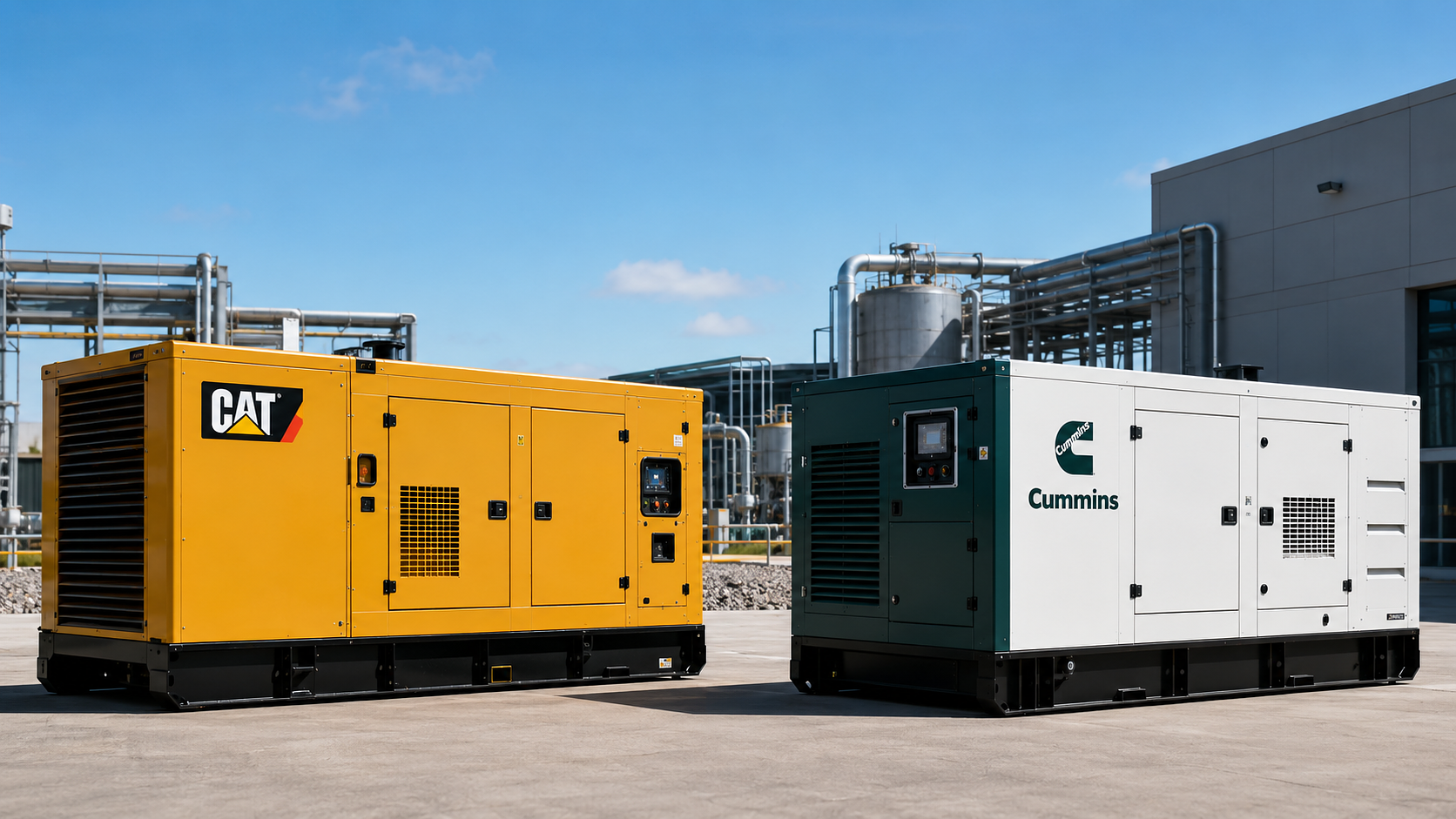
When buyers call ARC Power Systems looking for an industrial generator, two names come up more than almost any others: CAT and Cummins.
The question usually sounds simple:
“Which one is better, CAT or Cummins?”
The honest answer is that both are excellent brands. Both have earned their place in hospitals, data centers, quarries, manufacturing plants, construction sites, oil and gas facilities, utilities, and critical backup power applications.
But the better generator is not always the one with the bigger name. The better generator is the one that fits the job.
That means looking at:
- kW rating
- voltage
- fuel type
- emissions tier
- standby vs. prime vs. continuous rating
- hours
- controls
- enclosure
- breaker configuration
- service records
- testing history
- availability
- total installed cost
At ARC Power Systems, we do not look at this like a brand popularity contest. We look at it from the buyer’s side: What does the site need, what can be permitted, what is available now, and what gives the customer the lowest risk path to power?
The Short Answer
CAT is often the stronger choice when brand recognition, resale value, dealer support, heavy-duty packaging, and large natural gas power are top priorities.
Cummins is often the stronger choice when factory-integrated diesel packages, Tier 4 Final emissions compliance, PowerCommand controls, and broad diesel engine familiarity are top priorities.
But the real answer depends on the application.
A low-hour 2016 Caterpillar C32 1000kW Tier 2 Diesel Generator Set may be the better choice for standby power.
A newer 2022 Cummins 1000DQFAH 1000kW Tier 4 Final Diesel Generator may be better for a permitted industrial site that needs emissions compliance.
A fleet of CAT G3520 Natural Gas Generators may be the better answer for a data center, microgrid, or large continuous-duty power project.
The logo matters. The actual machine matters more.
Why Buyers Choose CAT Generators
CAT has one of the strongest names in the industrial power market. Buyers like CAT because it carries weight with engineers, contractors, owners, facility managers, and resale buyers.
CAT generators are commonly chosen for:
- mission-critical standby power
- rental-grade mobile power
- large natural gas generation
- data center backup and bridge power
- industrial facilities
- heavy-duty commercial sites
- oil and gas infrastructure
- utility support
- prime and continuous-duty applications
One of the biggest strengths of CAT is confidence. A CAT generator is usually easy for a buyer, engineer, or project manager to understand. The brand has strong recognition, strong support, and strong resale demand.
For example, ARC’s 2016 Caterpillar C32 1000kW Diesel Generator Set is a premium standby package with only approximately 42.6 hours since new. For a buyer who needs a low-hour 1MW standby generator, that type of unit is hard to ignore.
For mobile power, ARC’s 2019 Caterpillar XQ570 455kW Prime Tier 4 Final CARB Towable Generators are strong options for rental fleets, construction sites, quarries, screening plants, and temporary industrial power.
For large natural gas projects, ARC’s CAT G3520 Natural Gas Generators are in a different class. These units are listed at 2.6MW each, 13.8kV, continuous-rated, and available in a multi-unit package up to 26MW.
That is where CAT really separates itself: large natural gas power, premium standby diesel, and heavy-duty mobile packages.
Why Buyers Choose Cummins Generators
Cummins has one of the strongest diesel engine reputations in the world. Buyers know Cummins engines from generators, trucks, pumps, compressors, marine equipment, oilfield equipment, rental fleets, and industrial machinery.
Cummins generators are commonly chosen for:
- diesel standby power
- Tier 4 Final applications
- industrial prime power
- construction power
- quarry and aggregate power
- rental-grade generator packages
- commercial backup power
- factory-integrated controls
- strong engine parts familiarity
Cummins is especially strong when emissions compliance matters. Many modern Cummins packages include factory aftertreatment, PowerCommand controls, and clean integration between the engine, generator end, controls, and emissions system.
ARC’s 2022 Cummins 1000DQFAH 1000kW Tier 4 Final Diesel Generators are a strong example. These units are powered by Cummins QST30-G17 engines and include Tier 4 Final aftertreatment, making them practical for industrial buyers who need cleaner diesel power.
For larger diesel needs, ARC’s 2022 Cummins DQGAS QSK50-G8 1500kW Tier 4 Final Generator Sets offer serious output in a modern Tier 4 Final package.
Cummins also shows up inside packages from other manufacturers. For example, ARC’s 2015 Atlas Copco QAC1200 1000kW Tier 2 Diesel Generator Set is powered by a Cummins QST30-G5 engine. ARC’s Doosan G570 456kW Prime Towable Diesel Generator is powered by a Cummins QSX15-G9 engine.
That is one of Cummins’ biggest advantages: even when the outside badge says something else, the engine may still be Cummins.
CAT vs. Cummins for Standby Power
For standby power, both brands are strong.
Standby generators are used when utility power fails. These units may sit for long periods, exercise on a schedule, and then need to start immediately during an outage.
For standby power, the most important questions are:
- Will it start reliably?
- Is it properly sized?
- Is the voltage correct?
- Does it meet the site’s emissions requirements?
- Does it have service records?
- Has it been load bank tested?
- Are drawings and manuals available?
- Can it be delivered and installed quickly?
A low-hour CAT package like ARC’s 2016 Caterpillar C32 1000kW generator is a strong standby option where Tier 2 is acceptable.
A modern Cummins package like ARC’s 2022 Cummins 1000DQFAH Tier 4 Final generator may be the better fit where emissions compliance is a priority.
Standby verdict: Tie.
Better choice: CAT for low-hour premium standby value. Cummins for newer Tier 4 Final diesel compliance.
CAT vs. Cummins for Prime Power
Prime power is different. These generators are expected to run for longer periods and handle real operating loads.
Prime power is common in:
- quarries
- aggregate plants
- rock crushing operations
- screening plants
- construction sites
- remote facilities
- mining
- oil and gas
- temporary industrial power
For prime power, durability, fuel burn, radiator capacity, service access, emissions compliance, and load profile matter heavily.
The CAT XQ570 455kW Tier 4 Final towable generators are strong for mobile jobsite and rental-grade prime power.
The Doosan G570 powered by a Cummins QSX15-G9 is another practical prime-power option where Tier 2 is acceptable.
For larger 1MW-class diesel power, the Cummins 1000DQFAH Tier 4 Final units are especially attractive for quarry, aggregate, and industrial buyers who need serious power and modern emissions equipment.
Prime power verdict: Depends on the site.
Better choice: CAT for mobile Tier 4 Final rental-grade power. Cummins for large diesel prime applications where emissions compliance matters.
CAT vs. Cummins for Tier 4 Final Applications
This is where Cummins often becomes very attractive.
Tier 4 Final matters when the generator needs to operate in stricter emissions environments. That can include California job sites, construction projects, non-emergency industrial use, quarry operations, temporary power, and certain permitted facilities.
ARC’s 2022 Cummins 1000DQFAH 1000kW Tier 4 Final Diesel Generators and 2022 Cummins QSK50-G8 1500kW Tier 4 Final Generator Sets are strong examples of Cummins diesel packages built for this type of buyer.
CAT also has strong Tier 4 Final equipment, including ARC’s CAT XQ570 towable generator sets.
Tier 4 Final verdict: Cummins often has the edge in larger stationary diesel packages. CAT is very strong in mobile rental-grade Tier 4 Final power.
CAT vs. Cummins for Natural Gas Power
For large natural gas generation, CAT is usually the stronger name.
ARC’s CAT G3520 Natural Gas Generators are listed at 2.6MW each and available in a multi-unit package. These are the type of units buyers look at for:
- data center bridge power
- microgrids
- utility support
- behind-the-meter generation
- industrial base load
- oil and gas infrastructure
- large manufacturing loads
Cummins also has natural gas options, including ARC’s 2017 Cummins 500kW Natural Gas Generator Set, but in the larger multi-megawatt natural gas category, CAT has a very strong position.
Natural gas verdict: CAT wins for larger continuous-duty and multi-megawatt natural gas power. Cummins still makes sense for smaller natural gas standby applications.
Do Not Buy Based on Brand Alone
This is the part buyers need to slow down and understand.
A generator is not just an engine. A complete power system includes:
- engine
- alternator
- controls
- breaker
- radiator
- enclosure
- fuel tank
- emissions system
- exhaust system
- trailer or skid
- battery charger
- coolant heater
- manuals
- drawings
- service history
- load test documentation
That is why a Cummins-powered Atlas Copco package or Cummins-powered Doosan package can still be a very smart buy.
For example, the Atlas Copco QAC1200 1000kW generator is powered by a Cummins QST30 engine. The Doosan G570 456kW generator is powered by a Cummins QSX15 engine.
A smart buyer looks at the whole machine, not just the badge.
Best Choice by Application
Data Centers
For diesel standby, both CAT and Cummins are strong.
The CAT C32 1000kW generator is a strong low-hour standby option. The Cummins 1000DQFAH Tier 4 Final generator is a strong option when emissions compliance matters.
For natural gas bridge power or larger behind-the-meter generation, the CAT G3520 2.6MW units are the stronger fit.
Quarries and Aggregate Plants
For large diesel power, the Cummins 1000DQFAH Tier 4 Final units are strong candidates.
For mobile support power, the CAT XQ570 Tier 4 Final towable generators are a strong fit.
For budget-sensitive rental-grade power where Tier 2 is acceptable, the Doosan G570 powered by Cummins is also worth reviewing.
Manufacturing and Industrial Facilities
For 1MW standby power, compare the CAT C32 1000kW diesel generator against the Cummins 1000DQFAH Tier 4 Final generator.
For larger diesel power, review the Cummins QSK50-G8 1500kW Tier 4 Final generator sets.
For larger natural gas power, review the CAT G3520 natural gas generators.
Related CAT and Cummins Generator Listings
CAT Generator Listings
- 2016 Caterpillar C32 1000kW Tier 2 Diesel Generator Set
- 2019 Caterpillar XQ570 455kW Prime Tier 4 Final CARB Towable Generator Sets
- CAT G3520 Natural Gas Generators for Sale | 2.6MW Each
- Caterpillar G3512 750kW Natural Gas Generator Set
Cummins Generator Listings
- 2022 Cummins 1000DQFAH 1000kW Tier 4 Final Diesel Generators
- 2022 Cummins DQFAH QST30-G17 1000kW Tier 4 Final Certified Diesel Generators
- 2022 Cummins DQGAS QSK50-G8 1500kW Tier 4 Final Certified Diesel Generator Sets
- Cummins 800kW DFJB Diesel Generator Set
- Cummins 500DFEK 500kW Tier 2 Diesel Generator Set
- 2017 Cummins 500kW Natural Gas Generator Set
- 2017 Cummins C500D6RG Rental Grade Power Module
- 2005 Cummins KTA19 500kW Diesel Generator Set
- 2000 Cummins LTA10 250kW Diesel Generator Set
Cummins-Powered Generator Listings
- 2015 Atlas Copco QAC1200 1000kW Tier 2 Diesel Generator Set Powered by Cummins QST30
- Doosan G570 456kW Prime Tier 2 Rental Grade Towable Generator Set Powered by Cummins QSX15
You can also browse all available equipment through our industrial generator inventory or use our PowerMatch Tool to narrow down the right generator for your project.
Final Verdict: CAT or Cummins?
So, which one is better?
CAT is usually better when the buyer wants maximum brand recognition, resale value, dealer support, and large natural gas power options.
Cummins is usually better when the buyer wants factory-integrated diesel packages, strong Tier 4 Final options, PowerCommand controls, and broad diesel engine familiarity.
But the best generator is the one that fits the job.
At ARC Power Systems, we help buyers compare more than just the logo. We look at rating, voltage, emissions, hours, controls, condition, packaging, testing, documentation, and real-world application.
If you are comparing CAT, Cummins, or Cummins-powered generator packages, contact ARC Power Systems and we will help you match the right unit to the right project.
Call or text ARC Power Systems: (213) 371-2848
Email: sales@arcpowersystems.com
Browse current inventory: ARC Power Systems Industrial Generators