
When a business starts shopping for a commercial generator, the first question is usually simple:
“What size generator do I need?”
But the real answer lives inside a group of electrical terms that many buyers see every day but do not fully understand:
kW, kVA, amps, voltage, and phase.
These numbers are not just technical details. They determine whether a generator will actually work for your building, your equipment, your switchgear, your transfer switch, and your real load during an outage.
A generator can look perfect on paper and still be wrong for the job if the voltage does not match, the amperage is too low, the phase is incorrect, or the buyer confuses kW with kVA.
For commercial and industrial buyers, this is where expensive mistakes happen.
This guide breaks it down in plain English.
Start With the Most Important Number: kW
Most commercial and industrial generators are advertised by kilowatt rating, written as kW.
Examples:
- 100kW commercial generator
- 250kW diesel generator
- 500kW standby generator
- 1000kW industrial generator
- 1500kW prime power generator
- 2000kW backup generator
The kW rating tells you how much real usable power the generator can produce.
In simple terms:
kW is the working power.
It is the power your equipment actually uses to operate.
Your lights, compressors, pumps, refrigeration systems, HVAC units, production equipment, computers, controls, motors, and machinery all consume real power. That real usable power is measured in kilowatts.
When someone asks, “What size generator do I need?” they are usually asking how many kW they need.
But kW is only part of the picture.
What Is kVA?
You may see a generator listed with two ratings:
1000kW / 1250kVA
At first glance, this can look confusing. Why does the same generator have two different numbers?
The answer is power factor.
kVA stands for kilovolt-amps. It measures apparent power, which is the total electrical capacity being supplied before accounting for power factor.
In simple terms:
kVA is the total power capacity.
kW is the usable working power.
For many industrial generators, the common power factor is 0.8.
That gives you the common formula:
kW = kVA × Power Factor
So if a generator is rated at 1250kVA with a 0.8 power factor, the usable kW is:
1250 kVA × 0.8 = 1000kW
That is why a generator may be listed as:
1000kW / 1250kVA
Those numbers are connected. They are not competing ratings.
Quick Formula: kW and kVA
Use these basic formulas:
kW from kVA
kW = kVA × Power Factor
Example:
1250kVA × 0.8 = 1000kW
kVA from kW
kVA = kW ÷ Power Factor
Example:
1000kW ÷ 0.8 = 1250kVA
What Are Amps?
Amps measure electrical current.
If kW tells you how much power the generator can produce, amps help tell you how much current is flowing through the system at a specific voltage.
This matters because your generator, breaker, transfer switch, cables, switchgear, and facility service all need to be compatible.
A 1000kW generator at 480V produces a very different amperage than a 1000kW generator at 208V.
Same kW. Different voltage. Very different amperage.
That is why voltage matters so much.
Why Voltage Changes Everything
Voltage is the electrical pressure of the system.
Common commercial and industrial generator voltages include:
- 208V 3-phase
- 240V 3-phase
- 277/480V 3-phase
- 600V 3-phase
- 4160V medium voltage
- 13.8kV medium voltage
Many larger commercial and industrial facilities use 480V 3-phase power. Smaller commercial buildings may use 208V 3-phase.
Before buying a generator, you need to confirm your facility voltage.
Do not guess.
Do not assume.
Do not buy based on kW alone.
A 480V generator may not directly match a 208V building unless transformers, switchgear, and electrical design are properly accounted for.
A generator may also be reconnectable for multiple voltages, but that must be verified by the generator end, wiring configuration, controls, breaker, and qualified electrical review.
What Is Phase?
Commercial and industrial buyers usually deal with three-phase power.
Residential properties are usually single-phase. Commercial and industrial facilities commonly use three-phase because it is better suited for motors, compressors, pumps, HVAC systems, manufacturing equipment, refrigeration systems, and large electrical loads.
For this blog, we are focusing on commercial and industrial applications.
The two main categories are:
Single-phase power
Usually found in residential or very small commercial applications.
Three-phase power
Common in commercial buildings, industrial plants, supermarkets, warehouses, cold storage facilities, food processing facilities, data centers, oilfield sites, and manufacturing operations.
Most industrial generators we handle are three-phase generator sets.
Before buying, confirm whether your facility is:
- Single-phase
- Three-phase
- 208V 3-phase
- 480V 3-phase
- Another voltage configuration
A three-phase generator is not automatically correct just because the kW looks right. The voltage and connection type still need to match your application.
The Commercial Generator Calculation Formula
For most commercial and industrial generator sizing, the most useful formula is the three-phase power formula.
Three-Phase kW Formula
kW = Volts × Amps × Power Factor × 1.732 ÷ 1000
Where:
- Volts = system voltage
- Amps = electrical current
- Power Factor = commonly 0.8 for many industrial generator ratings
- 1.732 = square root of 3, used for three-phase power
- 1000 = converts watts to kilowatts
Three-Phase Amps Formula
If you know the kW and want to calculate amps:
Amps = kW × 1000 ÷ Volts ÷ Power Factor ÷ 1.732
This is one of the most useful formulas for commercial generator buyers.
Example: How Many Amps Does a 1000kW Generator Produce at 480V?
Let’s use a common industrial generator example:
- Generator size: 1000kW
- Voltage: 480V
- Phase: 3-phase
- Power factor: 0.8
Formula:
Amps = kW × 1000 ÷ Volts ÷ Power Factor ÷ 1.732
Calculation:
1000 × 1000 ÷ 480 ÷ 0.8 ÷ 1.732 = approximately 1504 amps
So a 1000kW, 480V, 3-phase generator produces approximately:
1504 amps at full load
That is why you may commonly see a 1000kW generator paired with a 1600A main breaker.
The breaker size, generator output, switchgear, and transfer switch must all be reviewed together.
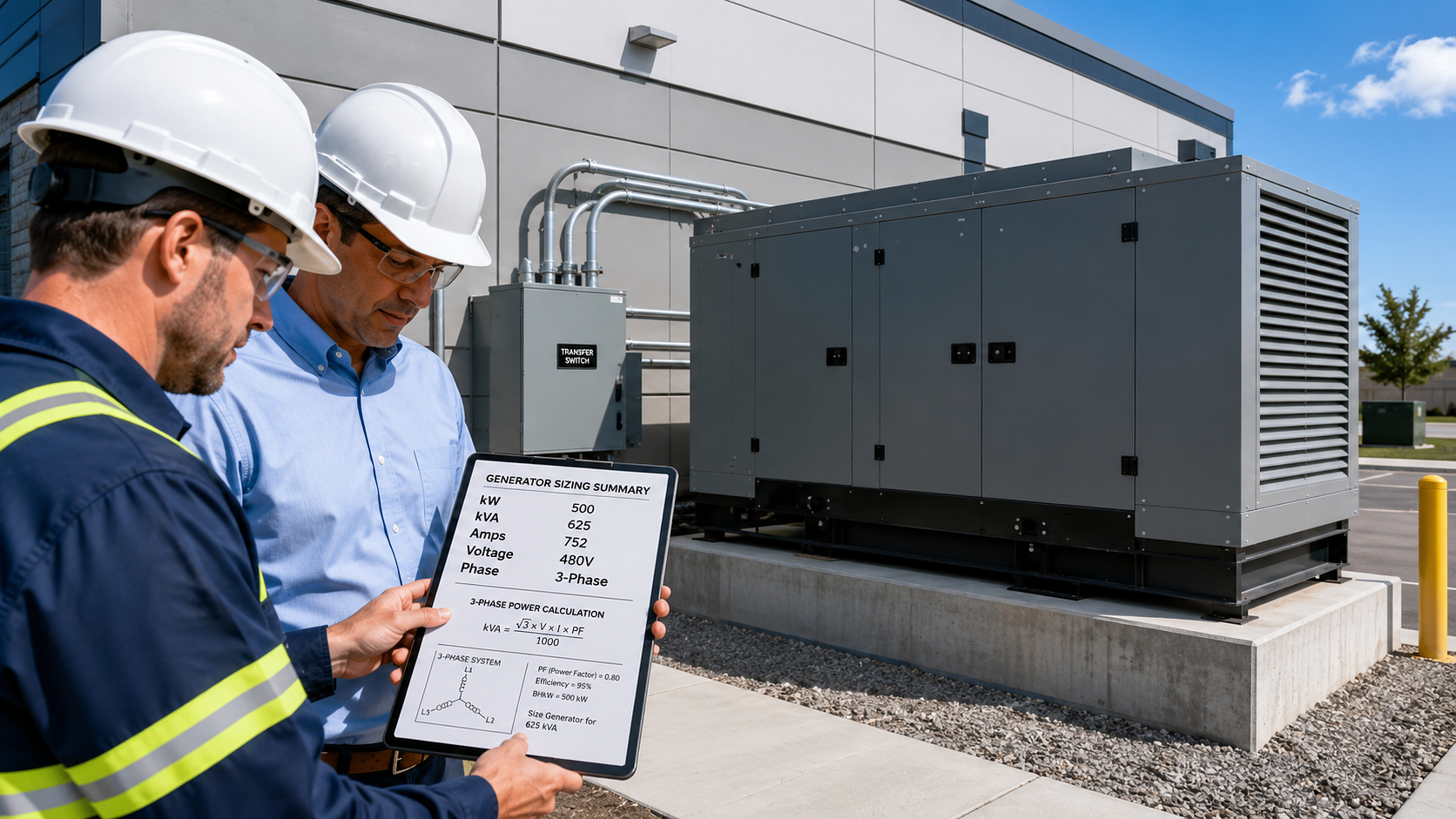
Example: How Many Amps Does a 500kW Generator Produce at 480V?
- Generator size: 500kW
- Voltage: 480V
- Phase: 3-phase
- Power factor: 0.8
Formula:
500 × 1000 ÷ 480 ÷ 0.8 ÷ 1.732 = approximately 752 amps
So a 500kW, 480V, 3-phase generator produces approximately:
752 amps at full load
Example: How Many Amps Does a 250kW Generator Produce at 208V?
- Generator size: 250kW
- Voltage: 208V
- Phase: 3-phase
- Power factor: 0.8
Formula:
250 × 1000 ÷ 208 ÷ 0.8 ÷ 1.732 = approximately 868 amps
So a 250kW generator at 208V produces approximately:
868 amps at full load
This is why lower voltage systems require more amperage for the same kW.
That higher amperage affects:
- Cable size
- Breaker size
- Transfer switch size
- Switchgear
- Installation cost
- Electrical design
Why the Same Generator May Not Work for Every Building
A buyer may find a clean used 1000kW diesel generator for sale and think the hard part is over.
But the generator still needs to match the site.
Before purchasing, confirm:
- Generator kW rating
- Generator kVA rating
- Voltage output
- Three-phase or single-phase
- Power factor
- Main breaker size
- Existing service amperage
- ATS size
- Switchgear compatibility
- Cable requirements
- Load type
- Motor starting requirements
- Emissions requirements
- Standby, prime, or continuous rating
A generator that is perfect for one facility may be wrong for another.
For example, a 480V generator may be ideal for a manufacturing plant but not directly suitable for a 208V commercial building unless the system is designed for it.
A 1000kW generator may be more than enough for one facility but undersized for another if the second facility has large motor-starting loads, refrigeration compressors, chillers, or production equipment.
This is why commercial generator sizing must be application-specific.
Running Load vs Starting Load
One of the biggest mistakes in generator sizing is only looking at running load.
Many commercial and industrial systems need more power to start than they need to keep running.
This applies to:
- Motors
- Pumps
- Compressors
- Chillers
- HVAC units
- Refrigeration systems
- Conveyors
- Production machinery
A compressor may only need a certain number of amps while running, but it may require much more current for a short moment during startup.
That startup demand is called inrush current or starting current.
If the generator is not sized to handle starting load, the result can be:
- Voltage drop
- Failed motor starts
- Tripped breakers
- Generator overload
- Equipment damage
- Unstable operation
For supermarkets, cold storage, food processing, and manufacturing, this is especially important.
The generator has to do more than carry the running load. It must also handle how the load comes online.
Why Power Factor Matters
Power factor measures how efficiently electrical power is being used.
For simple planning, many industrial generator ratings use 0.8 power factor.
That means a 1250kVA generator is commonly rated for 1000kW of usable power.
However, real facilities do not always operate at perfect or predictable power factor.
Power factor can be affected by:
- Motors
- Transformers
- Welders
- Variable frequency drives
- UPS systems
- Data center equipment
- Heavy industrial machinery
- Nonlinear electrical loads
This is another reason not to rely only on a basic calculation.
The formula gives you a starting point. The actual generator recommendation should consider the type of load.
What Information Should You Collect Before Shopping?
Before calling a generator supplier or requesting a quote, gather as much of the following information as possible:
- Facility voltage
- Single-phase or three-phase service
- Main electrical service size
- Existing ATS size, if any
- Existing switchgear information
- Critical equipment list
- Running amps for major equipment
- Starting amps for motors and compressors
- Required kW load
- Required runtime
- Fuel preference
- Standby, prime, or continuous application
- Indoor or outdoor installation
- Space limitations
- Emissions requirements
- Location of the project
Even a photo of your electrical gear can help start the conversation.
Useful photos include:
- Main service panel
- Switchgear nameplate
- ATS nameplate
- Existing generator nameplate
- Breaker labels
- Major equipment nameplates
- Electrical one-line diagram, if available
The more accurate the information, the better the generator match.
The Simple Way to Think About It
For commercial buyers, the relationship between these terms can be simplified:
Voltage tells you what electrical system the generator must match.
Phase tells you whether the system is single-phase or three-phase.
Amps tell you how much current is flowing.
kVA tells you the apparent power capacity.
kW tells you the usable working power.
A generator must line up across all of these categories.
Not just one.
Not just kW.
Not just price.
Not just brand.
The right commercial generator is the one that matches the facility’s electrical system, load profile, application, runtime, emissions requirements, and installation plan.
Common Buyer Mistakes
Avoid these mistakes when shopping for a commercial or industrial generator:
Mistake 1: Buying based only on kW
A 500kW generator is not automatically right just because your estimated load is near 500kW. Voltage, amps, phase, starting load, and rating still matter.
Mistake 2: Ignoring voltage
A 480V generator may not directly match a 208V facility. This can create expensive installation changes.
Mistake 3: Confusing kW and kVA
A 1250kVA generator is not the same as a 1250kW generator. At 0.8 power factor, 1250kVA is typically 1000kW.
Mistake 4: Forgetting motor starting loads
Large motors, compressors, pumps, and refrigeration systems may require much more power to start than to run.
Mistake 5: Not checking the ATS
Your generator must work with the transfer switch and switchgear. A generator purchase should not be separated from the electrical system it connects to.
Mistake 6: Assuming all three-phase generators are the same
208V 3-phase and 480V 3-phase are very different systems. Confirm before buying.
Mistake 7: Not verifying emissions requirements
Even if the electrical match is correct, the generator still needs to be legal and practical for the application and location.
Final Answer: How Do You Calculate kW, kVA, Amps, Voltage, and Phase?
For a commercial generator, use these core formulas:
kW from kVA
kW = kVA × Power Factor
kVA from kW
kVA = kW ÷ Power Factor
Three-phase kW
kW = Volts × Amps × Power Factor × 1.732 ÷ 1000
Three-phase amps
Amps = kW × 1000 ÷ Volts ÷ Power Factor ÷ 1.732
For most commercial and industrial generator planning, assume three-phase power and verify whether your system is 208V, 480V, or another voltage.
Then confirm the actual load, starting requirements, ATS size, switchgear, fuel plan, runtime needs, and emissions requirements before purchasing.
The calculation gets you close.
The full application review gets you the right generator.
ARC Power Systems Can Help You Match the Numbers to the Right Generator
At ARC Power Systems, we help commercial and industrial buyers avoid costly generator mismatches.
If you are trying to determine the right commercial generator size, we can help review:
- kW requirement
- kVA rating
- Voltage
- Phase
- Amperage
- Starting load
- Fuel type
- Runtime
- Standby vs prime application
- Emissions requirements
- ATS and switchgear compatibility
- Physical package requirements
Buying the wrong generator can cost more than the generator itself. The right unit should fit your load, your electrical system, your location, and your business risk.
Use our Power Match Tool to get started:
https://www.arcpowersystems.com/pages/use-our-powermatch-tool
Or contact ARC Power Systems directly with your voltage, phase, load details, and project location. We will help narrow the search before you spend money on the wrong unit.
📞 Call or Text: (213) 371-2848
📧 Email: sales@arcpowersystems.com